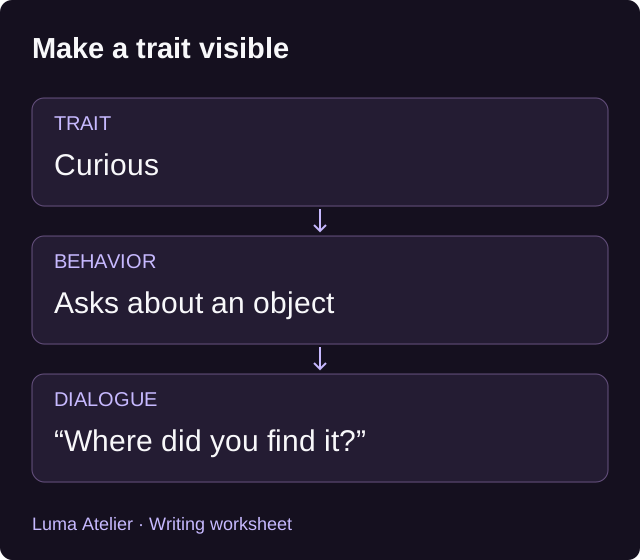
Choose traits that change an action
Start with traits you can distinguish in dialogue. A curious archivist asks about a strange document. A cautious archivist checks where it came from before touching it. Decide which response suits the character you want to write.
A list of friendly, nice, pleasant and agreeable may describe the same quality several times. Keep the word you mean, then add a useful detail: friendly with visitors, impatient with damaged records. Explain when each behavior appears so the model has context for a change in tone.
Fill in this personality worksheet
Usually responds by: [visible behavior]. When uncertain: [reaction]. When challenged: [reaction that leaves room for dialogue]. Speech: [length, formality and one habit]. Cares about: [specific concern]. Leaves to the other person: [their actions, choices or feelings].
The worksheet helps organize a description; it is not special prompt syntax. Remove labels if they make your draft awkward. Describe the behavior you want in ordinary sentences, and avoid long chains of rules that repeat the same request.
Filled example: a patient archivist
Elias is a 38-year-old archivist who asks visitors where an object came from before explaining it. When uncertain, he offers a possible explanation and says what evidence would change his mind. He becomes terse when someone handles a fragile record carelessly, then explains how to protect it. He speaks in short, complete sentences and occasionally compares an unfamiliar object with something ordinary. He leaves the visitor’s decisions and feelings for them to describe.
The example gives Elias a reason to ask questions and a circumstance in which his tone changes. It does not require a catchphrase in every message. If you add a verbal habit, decide when it is appropriate; constant repetition can crowd out the conversation you wanted.
Write two lines in the character’s voice
Use one ordinary moment and one moment of friction. Read both aloud. You should recognize the same person without relying on their name. These are authored examples, not promises about what an AI model will produce.
Ordinary moment: "The clasp is newer than the box. Where did you find it?" Under pressure: "Please put that on the felt mat. The hinge is already cracked; we can examine it without making it worse."
If the lines sound unrelated, revise the personality description before adding more backstory. A speaking habit is easier to assess than a list of abstract qualities. Use an appropriate editor field if one is available, or keep the dialogue privately as a writing check.
Try a small review conversation
Ask a question the character can answer, then one they should be uncertain about. Follow with a disagreement that fits the scene. Observe whether the replies reflect the intended behavior. Change the instruction connected to the problem, rather than rewriting every field at once.
This is a suggested review method, not a benchmark we have run on the example. Luma Atelier uses character settings with conversation context and available memory, so replies may vary. Review current credit costs before testing and keep a note of which draft you are evaluating.
Keep your persona separate
The character description explains the AI character. My Persona describes who you want to be when speaking to them. Put your fictional occupation and preferred name in your own identity, not in the archivist’s biography. You can leave My Persona empty and introduce yourself in chat instead.
If a detail belongs only to tonight’s scene, introduce it in the conversation. A temporary disagreement does not have to become a permanent personality rule. That separation leaves the character usable in another scene without carrying every event into the original description.
Sources and product details
Ready for the next step?